
When the Hardest Transition Is the One Nobody Talks About
I have spent years talking about transition.
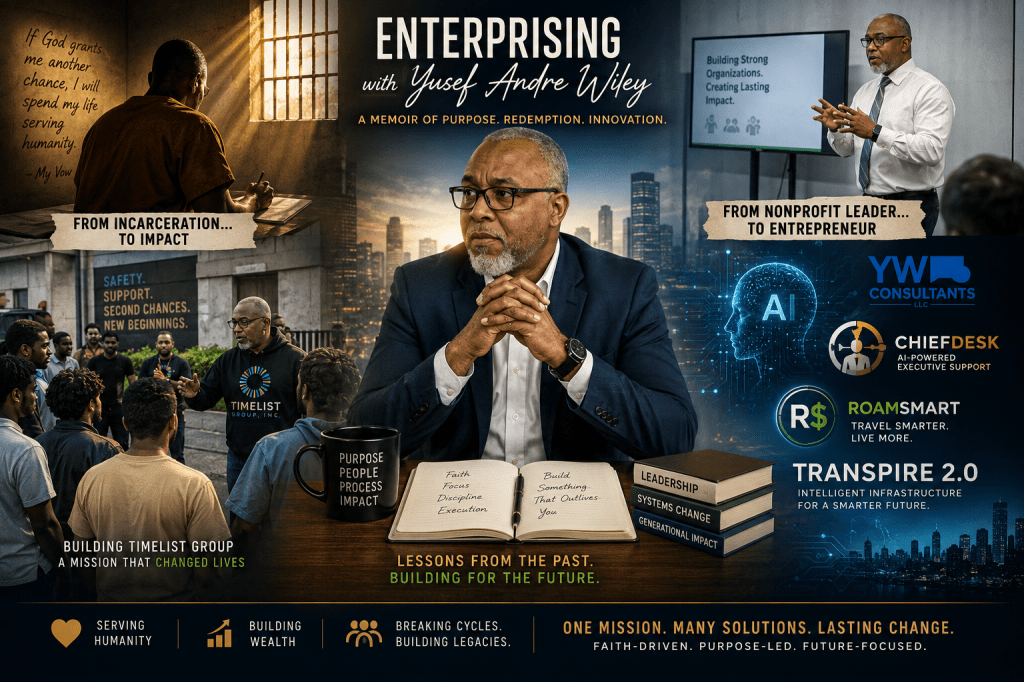
Transitioning from incarceration back into society. Transitioning from surviving systems to navigating them. Transitioning from being someone decisions were made about to becoming someone sitting at the table where decisions are made.
But I am beginning to recognize another transition in my own life—one that may prove to be just as complicated.
I am preparing to enter a new chapter.
And this time, I am being forced to talk about something we often avoid: what happens when an African American leader attempts to move beyond the circles, roles, and expectations that once defined him?
I have learned that success does not automatically free you from bias.
Sometimes success simply introduces you to a different version of it.
The Box Changes, but the Box Is Still There
As a Black man with lived experience in the justice system, there are certain spaces where people understand how to categorize me.
Formerly incarcerated.
Justice-involved leader.
Community advocate.
Reentry expert.
Those descriptions are part of my experience, and I will never run from them. My lived experience gave me an understanding of systems that cannot be learned from a textbook, a policy memo, or a graduate program.
But lived experience was never supposed to become a ceiling.
At some point, a person should be allowed to evolve beyond the category through which people were first introduced to him.
That is where the next challenge begins.
Because when a Black leader begins moving from participant to executive, from advocate to strategist, from community voice to institution builder, the reception can change.
The resistance does not always come from where you expect it.
Racism Does Not Only Operate Through Open Doors and Closed Doors
We often discuss racism as though it exists only between racial groups.
The reality is more complicated.
Racism creates systems, incentives, expectations, stereotypes, and definitions of legitimacy. Those ideas can become so deeply embedded in institutions that people living within the same racial community can sometimes reproduce them.
That is difficult to say.
It is even more difficult to experience.
There can be an unspoken expectation about what kind of Black leadership is acceptable.
You can tell your story—but don’t become too powerful.
You can advise the institution—but don’t expect to run it.
You can represent the community—but don’t outgrow the role others assigned you.
You can be celebrated for surviving—but your ambition may receive a very different response.
And sometimes the gatekeeper standing in front of the next opportunity looks like you.
That does not make Black people the problem.
It demonstrates how powerful the problem is.
Systems of racial hierarchy can teach all of us who is supposed to lead, who is supposed to follow, whose expertise is legitimate, and whose success needs additional explanation.
We have to be courageous enough to examine that—even within our own circles.
When Lived Experience Becomes a Cage
There is another uncomfortable reality facing justice-involved professionals.
Organizations increasingly value lived experience.
That is progress.
But there is a major difference between valuing someone’s lived experience and valuing the entire person.
If I can advise you about incarceration but cannot advise you about organizational strategy, something is wrong.
If I can speak on a reentry panel but cannot be considered for executive leadership, something is wrong.
If my story is valuable enough for your conference but my expertise is not valuable enough for your boardroom, something is wrong.
And if I spend years developing programs, managing organizations, understanding government systems, building partnerships, solving operational problems, and producing results—yet I am continuously introduced primarily by the worst chapter of my life—then lived experience has stopped being recognition.
It has become confinement.
I refuse that confinement.
There Is Another Side to Representation
Representation matters.
But representation without opportunity can become symbolism.
Organizations can surround themselves with Black faces while maintaining the same assumptions about authority, expertise, credibility, and power.
And those assumptions can appear in our own organizations and communities too.
We should be willing to confront that without turning against one another.
Calling this out is not anti-Black.
It is precisely because I believe in Black leadership that I believe we have to discuss the forces that sometimes restrict it.
We cannot demand that America stop placing ceilings over Black people while refusing to examine the ceilings we occasionally place over one another.
We cannot celebrate Black excellence only when that excellence remains familiar, comfortable, or subordinate.
And we cannot ask people to transform their lives and then become uncomfortable when they actually transform.
I Am No Longer Asking Permission to Evolve
This next chapter requires something different from me.
It requires me to stop shrinking my experience so that other people can comfortably understand it.
I can have been incarcerated and become an executive.
I can understand the streets and understand government.
I can possess lived experience and executive experience.
I can advocate for people impacted by systems and advise the institutions responsible for changing those systems.
I can honor where I came from without remaining professionally trapped there.
These are not contradictions.
They are the evolution of a human being.
And perhaps that is the larger conversation we need to have about reentry.
Successful reentry should not simply mean that someone came home and stayed out of prison.
Eventually, it should mean that person gained the freedom to become something nobody predicted.
Preparing for a Whole New Challenge
So I am preparing myself.
Not for another reentry.
For another level.
And I understand now that every level carries a different fight.
The challenge ahead may involve confronting institutional racism in places where it is sophisticated enough to hide behind qualifications, relationships, funding decisions, titles, and access.
It may require confronting bias within circles where I once expected automatic understanding.
It may mean losing relationships with people who were comfortable with who I was but are uncomfortable with who I am becoming.
It may mean walking into rooms where neither my past nor my race fits the traditional picture of executive authority.
So be it.
I did not survive everything behind me simply to become afraid of what is ahead of me.
My past gave me perspective.
Leadership gave me responsibility.
Experience gave me expertise.
And this next chapter will require me to bring all three.
There are people coming behind me who should not have to choose between honoring their lived experience and expanding beyond it. They should not have to remain permanently attached to their trauma in order to maintain credibility. They should be able to move from the program to management, from management to executive leadership, from executive leadership to ownership, investment, policy, philanthropy, government, and wherever else their abilities can take them.
That is what real transformation looks like.
And sometimes transformation requires confronting uncomfortable truths—even inside the communities and circles we love.
I am prepared to do that.
Because I am no longer interested only in proving that people like me can come home and succeed.
I am interested in what happens when we decide there is no limit to how far we can go.
This is a whole new challenge.
And I am preparing for it.


Leave a comment